WhatsApp, SMS or email: which booking channel fits your salon?
Compare WhatsApp, SMS and email as booking channels for your salon, see how the WhatsApp booking software market works in Europe, and learn what to check before you pay for any of it.
July 28, 2026
Most salon software comparisons argue about features. Very few ask the question that actually changes your day: where does the booking conversation happen?
That answer is not the same everywhere. In Spain, Germany and most of Latin America, an entire software category has grown around booking by WhatsApp, with tools like Marai, Waicita, Engrana or Gili.ai. In the United States and Canada, the same job is usually done over SMS and email, because that is where clients already are.
This guide compares the three channels honestly, explains how the European WhatsApp booking market is structured, and flags the costs that pricing pages tend to leave out. Replan sits in that market and is described with the same yardstick as everyone else, including what it does not do.
The problem is the same in every country
Your hands are busy with a colour. The phone rings. You stop, find a gap, write the appointment down and go back. Appointments live split between a paper book, your phone and unanswered chats. And in the morning you find a dead slot nobody filled.
The figures below are third-party observations about the sector, not a guarantee of results. They are useful for understanding where client habits are heading:
- According to Reservio, the industry sees no-show rates between 15% and 30%, and over 40% of bookings already happen outside business hours.
- According to WhatsApp Business, 80% of messages are read within the first five minutes, with an average open rate of 98%.
We covered what each ring really costs in WhatsApp booking vs phone calls. What changes from country to country is not the problem. It is which channel your clients will actually use to solve it.
WhatsApp, SMS and email side by side
Each channel behaves differently on the three things that matter for bookings: whether the client reads it, whether they can reply and finish the booking, and what it costs you.
| SMS | |||
|---|---|---|---|
| Client already has it | Yes, in Europe, Latin America and much of Asia | Yes, everywhere by default | Yes, but rarely checked in the moment |
| Two-way booking | Yes, the whole booking can happen in the thread | Possible, but usually limited to confirm or cancel keywords | Practically no, it sends you to a link |
| Cost model | Per conversation charged by Meta | Per message charged by your carrier or provider | Effectively free to send |
| Reads and replies | Very high, it is a personal app | High for alerts, lower for conversation | Lowest of the three |
| Best at | Booking, rescheduling and reminders in one thread | Reminders where WhatsApp is not common | Receipts, records and long detail |
The honest reading is that these channels are not competitors so much as different jobs. Email is a good archive and a poor booking channel. SMS is an excellent alert and a clumsy conversation. WhatsApp is the only one of the three where the entire booking can start and finish without leaving the thread, which is why the software category grew around it in the first place.
Where WhatsApp wins, and where it does not
This matters more than any feature list, so it is worth saying plainly.
WhatsApp is the default messaging app in Spain, Germany, Italy, the Netherlands, most of Latin America, India and large parts of Asia and Africa. In those markets, asking a client to install an app or hunt for a booking link is friction, while writing to the salon is what they already do.
In the United States and Canada it is different. SMS and iMessage still carry most personal messaging, and a salon there will usually get better results from SMS reminders plus a clean booking page than from pushing clients onto WhatsApp. If that is your market, the useful part of this guide is the channel comparison and the cost section, not the vendor landscape.
There is also a middle case worth naming: salons in the UK, Ireland and Australia, where WhatsApp use is significant but not universal. There, offering both a booking link and WhatsApp usually beats betting on one.
How the WhatsApp booking market is structured
If you are in a WhatsApp-first market, you will run into a lot of tools making the same promise with the same words, all adding "with AI". They fall into four quite different product models. Prices are from July 2026, taken from official pages, and are indicative only. Watch how tax is displayed, because providers do not present it the same way.
| Model | Examples | Price range (2026) | What to watch |
|---|---|---|---|
| Suites with a conversational AI assistant | Marai, Waicita, Happoin | Free tiers capped; paid from €26 to €99/mo | Free plans are limited (Marai free covers 50 appointments/mo, Waicita Lite 30 online bookings/mo) and there is a lot to configure |
| WhatsApp layers over your existing calendar | Engrana (ES), Gili.ai and Tellmin (DE) | €89 to €97/mo, sometimes with a setup fee (Gili.ai charges €280) | No calendar of their own, they plug into yours |
| Booking apps with WhatsApp included | EasyReserva, term-in, Blyssbook | €19 to €79/mo, or $11 to $79/mo | WhatsApp booking often sits in a mid or top tier, not the entry plan |
| Free calendar plus a WhatsApp layer | Replan | Calendar free and unlimited; WhatsApp booking €79/mo + VAT, plus Meta usage | No POS, stock, payroll or campaigns, by design |
Two observations that are easy to miss. First, the layer model is explicit about being a complement: Engrana describes itself in its own comparison as an add-on to your current system rather than full management software. Second, the fourth combination, a free calendar of your own plus a layer that also works over another system, is the least common on this map.
If what you actually need is a full management suite with stock and reporting, none of the above is the right frame and our hair salon and beauty software comparison is the better starting point.
The cost that pricing pages hide: messages
Almost no comparison explains this, and it is where the surprises live. WhatsApp is not free for businesses: Meta charges for certain conversations, and every provider decides how to pass that on. There are three patterns.
- A message quota bundled into the plan. Marai includes between 75 and 800 messages per professional per month depending on tier, and sells extra packs from €0.02 per message. EasyReserva includes 100 conversations a month and charges €0.07 for each extra one. Easy to understand, but the real price climbs if you exceed the quota.
- No declared limit. Blyssbook advertises unlimited WhatsApp messaging on every plan, which normally means the cost is averaged into the subscription.
- Meta's rate passed through at cost. This is how Engrana, Gili.ai and Replan work: a flat fee, plus the conversations Meta charges based on real usage, with no provider markup.
For Replan the split is published. Chatting from your own phone when you want to step in is free, and so are automated replies and appointment confirmations. Only proactive notifications are billed, meaning reminders, delay notices and reschedules, at Meta's exact official rate with no added commission. The published estimate is €5 to €7 per month for every 100 appointments, and usage is visible in real time from the calendar.
None of the three patterns is unfair. But when you compare, add the subscription and the messages together, because a €26 plan with a conversation quota and a €79 service with pass-through pricing cannot be judged on the first number alone.
How the booking actually happens: tight flow or open conversation
This is the biggest practical difference between tools and it almost never appears in a table. It is not about good bots and bad bots. Most of these products, Replan included, use an assistant that interprets what the client writes. The useful question is different: how much conversation are you asking a client to have in order to get an appointment?
There are two schools.
- AI receptionist with open conversation. The client explains what they want in their own words; the assistant asks questions, recommends, negotiates times and closes. Flexible, and genuinely good for a first-time client or a complicated service menu. In exchange the exchange runs longer and has more room to drift.
- Tight flow built on the calendar. The goal is the direct route: service, real gap, confirmation. Availability is not improvised, it comes from the calendar rules, so what gets offered is always a slot that exists.
That second one is Replan's approach, and it is worth describing without decoration. The booking is resolved by calendar logic, not by a language model choosing times. AI is reserved for a handful of specific topics such as opening hours, parking or a complaint, and runs at low temperature so its answers stay predictable. Nobody should have to argue with an assistant to get a haircut booked, and you can open the chat and take over by hand whenever you want.
To be fair in both directions: SchedulingKit, which is a booking software vendor rather than an independent study, argues that direct booking flows work better for clients who already know what they want, while conversational chat adds more when there is uncertainty or a complex menu, and recommends combining both. They publish conversion percentages, but without an open methodology, so we only take the qualitative point.
Applied to a salon, the nuance matters: a large share of appointments come from regulars repeating a service they already know. For that case, a short flow is usually a better experience than a conversation.
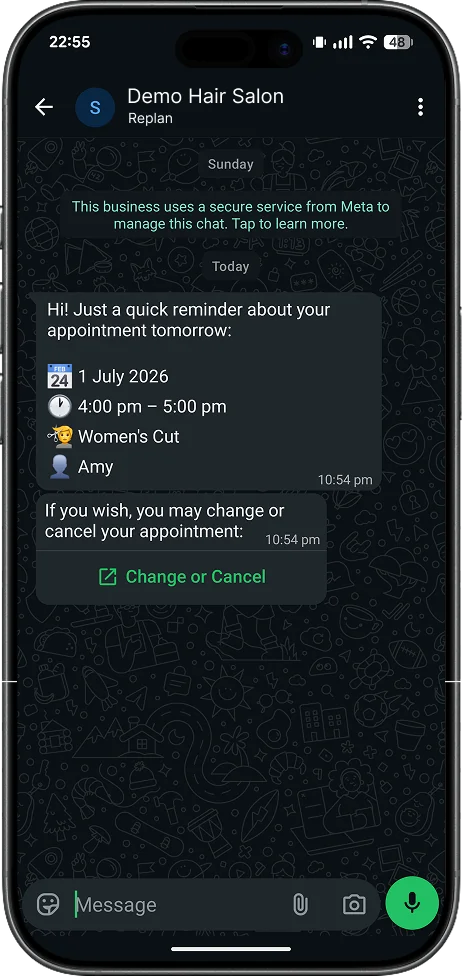
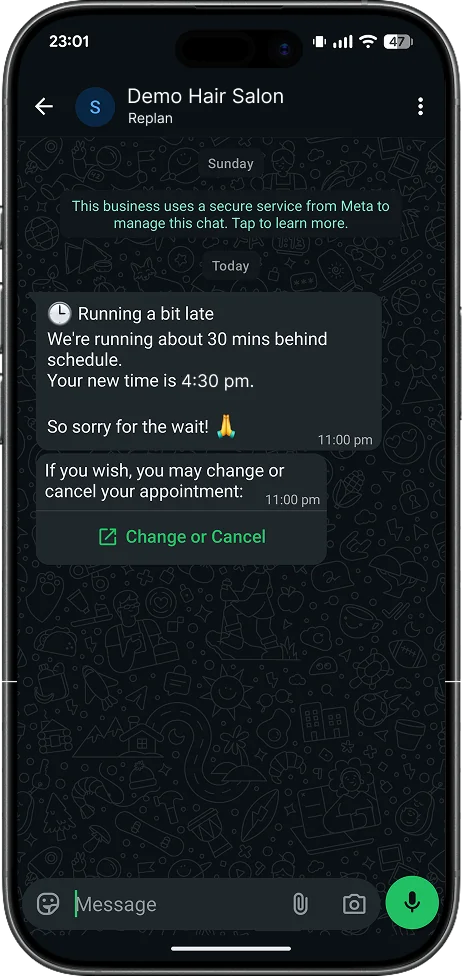
The step-by-step detail of how that flow works is in the WhatsApp booking guide. And if you would rather judge for yourself, run a real test booking from your own phone.
Two very different starting points
The same tool can be the right call or wildly oversized depending on where you begin.
Your salon has no management software yet
Appointments in a paper book, WhatsApp full of unanswered chats, the phone as the only door in. The risk here is not starting too small, it is starting too big: opening with a suite that has POS, stock and reporting usually ends in hours of setup to use 20% of the features.
The order that works is the reverse one. Get the calendar straight first, which is free and doable in an afternoon following the free calendar guide. Once the calendar reflects your real day, turn on WhatsApp booking. If you later need a till or inventory, you add another program for that.
Your salon already runs management software
Larger systems cover the till, stock, invoicing and reporting well. What many salons still suffer from is different: a calendar that is awkward in daily use, and self-service booking that clients barely touch because it means finding a link or opening an app.
This is where the layer model earns its place, and there are real options: Engrana or Gili.ai if your current calendar is fine and you only want the conversation solved, or Replan if you also want to change the calendar you work in every day. You do not have to abandon your current program. The decision is which piece solves which problem.
How to choose without buying more software than you need
Four questions sort this out better than any table:
- Which channel do your clients actually use? This one comes first, and it is geographical. Pushing WhatsApp in a market that lives on SMS is as wasteful as ignoring it in a market that lives on WhatsApp.
- What hurts today, the till or the phone? If it is stock, invoicing or reporting, no messaging layer will fix it and you need a suite. If it is the phone and the calendar, a suite is a long detour.
- How many appointments do you do a month? This is the question that reveals the real price. At higher volume, capped free plans and message quotas run out sooner than expected.
- What experience do you want your clients to have? A short flow for regulars, or a more open conversation if your menu is complex and clients ask a lot before deciding.
And a general rule that holds for most salons: fix the calendar chaos and the calls first, and leave the rest until you genuinely need it.
Quick questions
1.My clients are in the US and barely use WhatsApp. Is this relevant to me?
Partly. The channel comparison and the message cost section apply anywhere, but the vendor landscape does not. In a market where SMS and iMessage dominate, a clean booking page plus SMS reminders will usually outperform pushing clients onto WhatsApp. The underlying principle is the same either way: put the booking where your clients already are, and keep the calendar as the single source of truth.
2.Is Replan the only tool that lets clients book over WhatsApp?
No, and it is worth being clear about that. Marai and Waicita in Spain, or Gili.ai and Tellmin in Germany, also connect a calendar to WhatsApp so clients can book from the chat. What differs is the product model: how much software you buy alongside the booking, how much conversation the client is asked for, and how Meta's message charges reach your invoice.
3.Do I need an AI bot for WhatsApp booking to work?
Not necessarily. For a salon with clear services and returning clients, a short predictable flow usually closes more appointments and creates fewer misunderstandings than a long conversation. AI earns its place on questions outside the booking, such as opening hours or parking, or when your service menu is genuinely complex.
4.Why does Replan's WhatsApp add-on cost more than some broader suites?
Because they are different things, and comparing monthly figures alone misleads in both directions. Waicita Pro sits at €26 on promotion and Marai Pro at €59, with caps on appointments or messages depending on the tier. Replan is €79 plus VAT for the WhatsApp service, with a free unlimited calendar alongside it and Meta conversations passed through at cost. Within the dedicated layer model, where Replan belongs, Engrana is €89 and Gili.ai €97 plus a €280 setup fee.
Start with the calendar, at no cost
If this map leads you to conclude that your problem is not managing more things but stopping the phone from running your day, start with the cheap part: put your appointments in Replan's free calendar, with no cap on appointments or clients. When your salon is ready for bookings to arrive on their own, you switch on WhatsApp booking on that same calendar.
Create your free calendar in Replan
Got a question? Write to us at hello@replanapp.com.
Next read