WhatsApp booking for salons: stop taking calls
Automate WhatsApp booking for hair and beauty salons. Clients book 24/7 in the app they already use — and you stop living on the phone.
July 22, 2026
You're halfway through a colour. Your hands are covered, there's a client in the chair, and you're mid-conversation. Then the phone rings. You stop, wipe your hands, hunt for a free slot, jot down the appointment, and pick up where you left off. Ten minutes later, it rings again.
Each ring seems harmless. It isn't. It breaks your focus, cuts off the client already in your chair, and turns you into a receptionist while you're trying to work. And the call you don't manage to catch almost never comes back — it goes to the next salon on Google.
The problem isn't that you're disorganised. It's that you depend on the phone to take bookings, and the phone rings when it wants to, not when you're free. The alternative isn't to stop talking to your clients — it's to move routine bookings to a channel that doesn't interrupt, like WhatsApp connected to a simple calendar.
The phone and the broken day in your salon
No single call takes long. The problem is the total. Twenty or thirty calls spread across the week turn into a constant drip of micro-interruptions that fragment your day and wear the team down.
And there's a cost that rarely gets counted: the call that comes in while you're with another client. You can't take it without abandoning the person in front of you, so you let it go. No useful voicemail, no callback — that person doesn't wait. They book somewhere else.
For years, the answer to this chaos was "get more organised": a bigger diary, a tidier notebook, more discipline writing things down. But the mess doesn't come from the diary. It comes from the channel. As long as the only way to book is to call during your hours and wait for you to pick up, you'll stay tied to that ringtone.
And that's the detail that changes everything: as long as the only way to book is to call, your calendar will always react to the ring, not to how you want to shape your day. A simple calendar only hands you back control when appointments arrive through a channel that doesn't interrupt you.
How your clients actually want to book today
This isn't about demonising the phone — it's about looking at how people behave. Studies on online booking point to a clear trend: a growing share of clients, especially those under 40, would rather book online or by messaging than call. It's not that they hate the phone; typing is simply faster and less awkward for them.
And a lot of those bookings happen outside opening hours: late at night on the sofa, on a Sunday afternoon, on the bus home. Those are moments when your salon is closed and no one can answer the phone. If calling is the only channel, all that intent to book simply disappears.
WhatsApp fits this shift naturally because it's already on everyone's phone. Nothing to download, no passwords to remember, no link to dig out of an Instagram bio. According to WhatsApp Business, 80% of messages are read within the first five minutes and the average open rate is 98%. No email or push notification comes close.
Worth saying plainly: these are third-party observations about the industry, not a promise of results. This article leans on those trends to help you decide which channel suits you, not to promise you a full calendar. They show where client habits are heading; what happens in your salon depends on your work, not on a statistic.
What you lose when your salon depends on the phone
Staying in "calls only" mode has a cost that never shows up on an invoice, but you feel it in the till, in the calendar, and in your head at the end of the day.
Bookings that never arrive
The call you miss rarely rings twice. With no one to answer and no voicemail worth the name, the client moves on to the next result on Google. Every missed ring at peak time is, more likely than not, an appointment walking into another salon.
Time you never get back
Twenty to thirty calls a week are hours of skilled people's time spent hunting for slots and taking down details. That's time not spent on the client in the chair — which is where your business is actually built.
A fragile diary with no reminders
With appointments only on paper or in your head, there are no confirmations and no automatic reminders. Forgotten appointments multiply, no-shows too, and every reschedule depends on another manual call.
On top of that, there's the friction for the client. They have to call during your hours, wait for you to pick up, repeat their details, and sometimes hear "I can't right now, I'll call you back". Compared with booking quietly from their phone in twenty seconds, that's a lot to ask for something as simple as a haircut.
What changes when you book through WhatsApp and a simple calendar
Moving bookings to WhatsApp and a simple calendar isn't magic, and it doesn't guarantee anything on its own. What it does is take the ring out of the centre of your day and let appointments come in by themselves — organised, and with reminders.
Calls vs WhatsApp: three differences you feel every day
| What happens every day | Calls only | WhatsApp + calendar |
|---|---|---|
| Interruptions | You break off a service to answer | Appointments arrive without interrupting you |
| Out-of-hours bookings | Lost (no one picks up) | Captured 24/7 |
| Confirmations and reminders | Manual or non-existent | Automatic, where the client already reads |
24/7 bookings without interrupting services
A client can write and book at eleven at night or on a Sunday. A WhatsApp booking system shows them the real slots you've defined and schedules the appointment without you touching your phone. When you open the salon in the morning, those appointments are already in the calendar. You didn't answer a single call to get them.
Confirmations and reminders that actually land
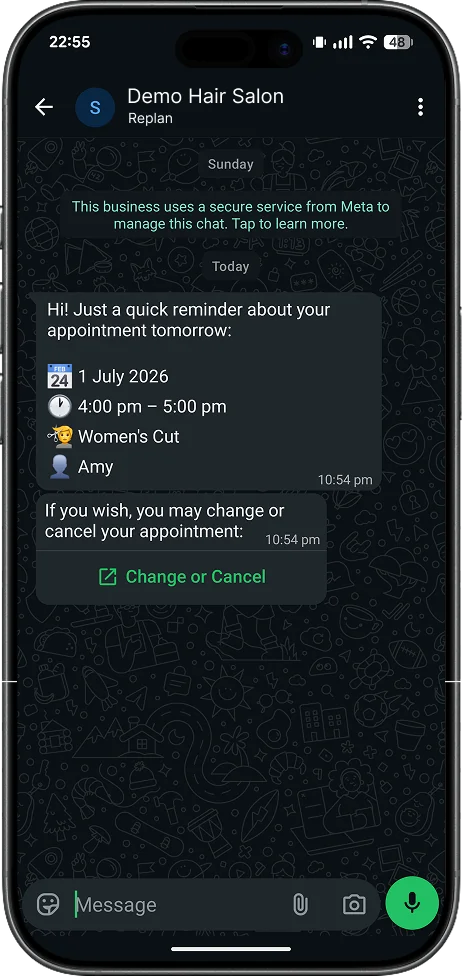
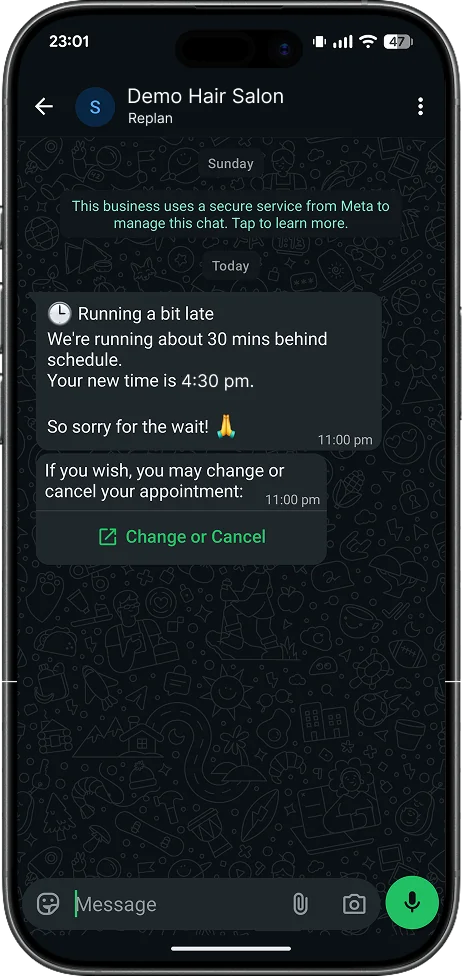
Other booking tools have documented the same thing for years: when automatic reminders go out, no-shows drop noticeably. What's different about WhatsApp is where that reminder lands — not in an inbox no one opens, but in the chat the client already checks every day. And if they need to change the time, they do it with a quick reply, freeing up the slot without an awkward call.
Fewer calls, more focus
The logic is simple: every booking that comes in through WhatsApp is a call you didn't have to take. Offering bookings away from the phone frees the team to focus on the person in front of them — which is where the value of your work lives.
This is where Replan fits, concretely: a free professional calendar to bring order to your diary, and a WhatsApp booking system so routine appointments come in on their own. No all-in-one software, no learning curve — just your calendar and a channel that doesn't interrupt.
Keeping the human touch
WhatsApp doesn't replace every conversation, and it shouldn't. Some clients want to talk, some questions need nuance, and some moments call for a voice rather than a message. The idea isn't to silence the phone — it's to strip it of its role as the default channel for everything. Routine bookings go to WhatsApp; the phone stays for what genuinely needs it.
The role of the phone in a salon that already books on WhatsApp
It's not "either I call or I use WhatsApp". The phone still makes sense in specific cases: a complex colour correction that needs discussing first, a client who prefers to hear a person, a delicate situation that's easier to explain out loud.
A simple rule works well in most salons: WhatsApp and online booking as the norm, the phone as the exception that adds value. That way the phone stops running your day and becomes just another tool, used when it adds something — not because it's the only way in. That's the real goal: not to kill the phone, but to stop it running your day.
How to move from calls to WhatsApp without losing clients
You don't need an inventory or a second booking system. The change is one: WhatsApp becomes how people book. The phone is for whoever still calls, not for running your day.
- Tell them to write on WhatsApp. Instagram, Google, the shop window or business cards don't need a booking link. The number and a clear line are enough: book on WhatsApp. The slots and the confirmation come in the chat itself, in the moment — not a link the client has to save.
- Look after whoever still calls. If someone rings, pick up: they're the ones who haven't caught on. You add that appointment to the calendar yourself, same place as the ones that come in through the chat. While they're in the chair, tell them next time to book on WhatsApp.
- Confirmation and reminder already come with the system. It isn't an extra switch. When bookings come in on WhatsApp, the client gets the confirmation and the day-before reminder in the same chat.
Quick questions
1.What if my clients are used to calling and don't really use WhatsApp?
The change doesn't happen from one day to the next. You introduce WhatsApp as the main option, keep calls as a fallback, and explain the benefit to the client: book whenever they like, without waiting for you to pick up, and get reminders. Most people switch on their own once they see how easy it is.
2.Can I stop taking calls entirely if I turn on WhatsApp booking?
Shutting off the phone overnight isn't a good idea. The usual setup in a salon is to keep it for specific cases — complex enquiries, clients who prefer to talk — and let WhatsApp and online booking absorb most of the routine appointments. The goal is for the phone to stop running the show, not to disappear.
3.Do WhatsApp bookings really reduce no-shows?
Industry studies and other providers report significant reductions when automatic reminders and confirmations are used. Those are third-party figures, not a number Replan promises you. What is verifiable is that a WhatsApp reminder gets read far more than an email, and that rescheduling from the chat stops the slot from going to waste.
4.What about clients who message on WhatsApp but never confirm the appointment?
That's the difference between a loose chat and a proper booking flow. With a link and automatic messages, the conversation ends in an appointment scheduled in your calendar — not in an "I'll confirm later" that gets lost. You can see how that flow works in the WhatsApp booking system guide.
Let the phone stop running your day
You don't have to change your whole system at once. The first step is simple: put your diary in a professional calendar and let WhatsApp handle the routine bookings. With Replan, the calendar is free forever and WhatsApp bookings connect straight into your day, so you can focus on the client.
Create your free calendar on Replan
Have any questions? Write to us at hello@replanapp.com.
Next read